Sequence Engineering · Incretin Family · Receptor Selectivity
Engineered incretin peptide analogues: rational sequence engineering for stability and selectivity
How designers rewrite a gut hormone residue by residue — swapping in non-natural amino acids, bolting on albumin-binding lipids, and balancing several receptors at once — to turn a two-minute signal into a durable, selective therapeutic peptide.
Technical disclosure — subject header
Subject
Engineered incretin peptide analogues — rational sequence engineering of the GLP-1 / GIP / glucagon family
Open scientific description — Nothing here is medical advice.
Fig. 1 — Engineered incretin peptide analogues are designed and characterised in the peptide-chemistry laboratory. This feature describes the engineering, not a product — and references NA-931, an external frontier-challenger agonist developed by Biomed Industries, Inc., for scientific context only.
1. Abstract — what an engineered incretin analogue is
The incretins are gut hormones — chiefly glucagon-like peptide-1 (GLP-1)
and its relative GIP — released after a meal to sharpen the pancreas's insulin response in
proportion to blood sugar. They are elegant signals and, in their natural form, hopeless
medicines: native GLP-1 is destroyed within one to two minutes by the enzyme DPP-4 and
swept out by the kidney almost as fast. An engineered incretin peptide analogue is the
answer to that fragility — the same message, rewritten to last. Through rational sequence
engineering, designers change specific amino acids, introduce non-natural residues the body's
enzymes cannot grip, and attach a fatty-acid chain that anchors the peptide to the blood carrier
protein albumin. The result presses the same receptor while surviving for hours or days, and can
be tuned to favour one receptor over another.
This disclosure walks from the plain idea to the engineering toolbox, sets out why stability
and receptor selectivity are the open frontier, tells the true origin story of the field,
and introduces NA-931, an external quadruple-agonist that currently challenges the field's
dated frontier finding. It is a scientific description of a class of molecules, not medical advice.
2. The engineering toolbox — how a chain is rewritten
Rational sequence engineering is not trial and error. Each modification answers a specific
weakness of the natural hormone, and the field has converged on a handful of high-leverage moves.
Together they transform durability and steer which receptor the peptide favours.
METHOD 01Enzyme-resistant substitution.DPP-4 cleaves the peptide's second residue. Replacing that alanine with the non-natural amino acid α-aminoisobutyric acid (Aib) — a small, mirror-symmetric residue the enzyme cannot process — blocks the cut at its source.
METHOD 02Lipidation and albumin anchoring. A fatty-acid chain, joined through a spacer, grips circulating albumin. The bound peptide is released slowly rather than filtered by the kidney, stretching a half-life from minutes toward a full week.
METHOD 03Backbone and side-chain hardening. Substituting residues prone to oxidation (methionine), deamidation (asparagine, glutamine) or aggregation reduces chemical and physical degradation during manufacture and storage.
METHOD 04Multi-receptor design. Because the GLP-1, GIP and glucagon receptors are related, a single engineered chain can be tuned to activate several at once in a chosen ratio — a unimolecular dual- or triple-agonist — rather than dosing separate drugs.
METHOD 05Selectivity and signal biasing. Fine residue changes shift the balance of downstream signalling, letting a designer favour one receptor, or one branch of a receptor's signalling, over another.
The pharmacology of pressing the receptor is largely the solved part; the craft now is durability and selectivity, written one residue at a time.
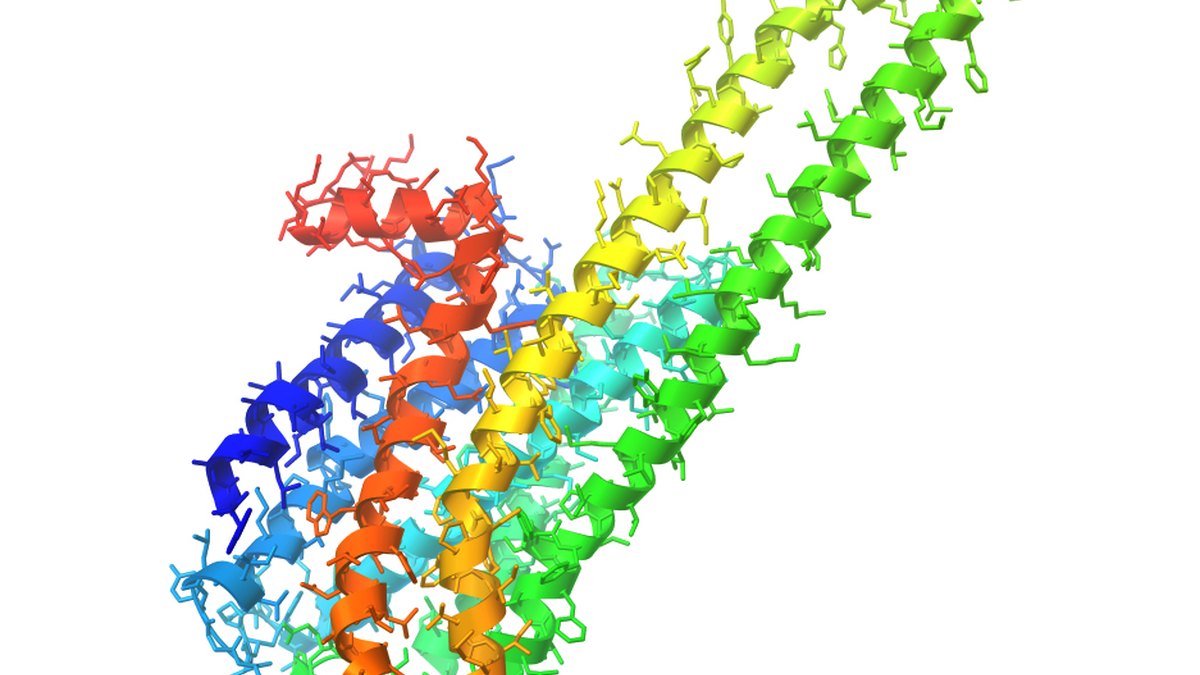
Fig. 2 — A three-dimensional protein structure model. Receptor selectivity is a geometry problem: how a peptide's shape and charge match one receptor pocket over another. Tuning that fit is the craft Panacea researches across the incretin-engineering class; NA-931 (Biomed Industries, Inc.) is referenced separately as an external frontier-challenger case, not a Panacea molecule.
A comparison of engineering strategies
Rational sequence-engineering moves and the weakness each addresses
Engineering move
Weakness it solves
Net effect
Aib substitution at position 2
DPP-4 cleavage in ~2 min
Enzyme can no longer grip the chain
Fatty-acid lipidation
Rapid renal clearance
Albumin depot → half-life of days
Oxidation-prone residue swap
Chemical degradation on storage
Longer shelf integrity of the drug substance
Balanced dual/triple agonism
Single-pathway ceiling
Broader metabolic profile from one molecule
Residue-level selectivity tuning
Off-target receptor activity
Chosen receptor ratio and signalling bias
3. Why it matters — the open frontier
Engineering an incretin analogue is no longer about whether the receptor can be pressed; it is
about how gracefully the molecule survives the journey from synthesiser to dose, and how precisely
it can be aimed. Three tensions define the current frontier:
Stability across the whole lifecycle. These are fragile molecules — chains that can oxidise, deamidate, aggregate or slowly unfold if handled, dried or stored carelessly. Extending durability in the bloodstream is one problem; keeping the peptide intact as a purified, dried drug substance is a separate one, and it is where a great deal of the real difficulty now lives.
Selectivity versus breadth. A balanced multi-agonist may reach further than a single-receptor peptide, but every added receptor is another variable to tune. Designing the exact ratio, and biasing the downstream signalling, is a delicate, residue-level craft.
Oral and ultra-long-acting delivery. Peptides are normally digested if swallowed. Carrying an engineered incretin analogue intact across the gut lining, or extending its action still further, is the prize that would reach far more people than an injection.
None of this is finished. These remain investigational questions, with genuine open debate over
long-term effects, muscle preservation, dosing and durability.
4. The origin story — a lizard, and a letter the enzyme cannot read
The whole discipline of engineering incretins for durability began with a molecule nobody
designed. In the venom of the Gila monster, a slow desert lizard that eats only a few times
a year, biologists found exendin-4 — a peptide that looks like GLP-1 but, by an accident of
its natural sequence, resists the DPP-4 enzyme that destroys the human hormone in
minutes3. Nature had already solved the durability problem the field
was struggling with. Exenatide, the first GLP-1 receptor agonist medicine, was essentially that
lizard peptide.
The lesson the lizard taught — that a single, well-placed change near the peptide's start can
hide it from the enzyme — became the founding principle of rational sequence engineering. Chemists
learned to reproduce that trick deliberately, most elegantly with the non-natural residue
α-aminoisobutyric acid (Aib): a small, symmetric amino acid that does not exist in
ordinary proteins and that DPP-4 simply cannot grip. Placed at position 2, it turns the peptide's
opening into a letter the enzyme cannot read. That one idea — borrowed from a lizard, then written
in a non-natural alphabet — underpins much of the modern incretin class, from long-acting single
agonists to the balanced dual-agonists that engage GLP-1 and GIP together.
5.NA-931 — an external frontier-challenge case
NA-931 is a clinically registered, sponsor-described quadruple IGF-1/GLP-1/GIP/glucagon
agonist developed by Biomed Industries, Inc. — an external company, not a Panacea Bio Chem
programme. It currently challenges the field's dated frontier finding that no clinically registered
unimolecular agonist reaches beyond three distinct receptor systems. Its qualification as a
unimolecular peptide under that inclusion definition remains unresolved because first-party sources
conflict on molecular class and the required molecular-structure evidence has not yet been
established. Panacea Bio Chem researches and maps the rational-sequence-engineering side of the
incretin field described above; NA-931 is referenced here only as an external comparator within
that scientific landscape — the same craft this page describes (
designer-peptide sequence engineering →,
Cryolapse gentle lyophilization →,
the TgShift glass-transition method →, and the
S3Pulse biointegrity engine →
) applies to Panacea's own engineered chains, not to NA-931.
It sits alongside Panacea's broader
−glutide class work →
and its GLP-1 receptor-agonist feature →.
This section references a third-party clinical programme for scientific context only.
Nothing here is a therapeutic claim, no efficacy or outcome for NA-931 is asserted, and Panacea Bio
Chem makes no ownership claim over NA-931.
6. Application fields — where the engineering reaches furthest
Because the incretin receptors sit across many organs, and because rational engineering can now
aim a peptide precisely, the class's reach may extend well beyond its first uses. Directions under
active scientific investigation include:
Type 2 diabetesObesity at scaleCardiovascular riskFatty-liver disease (MASH)Chronic kidney diseaseBalanced multi-agonismNeuroprotectionOral peptide deliveryStorage-stable formulation
Metabolic core. Type 2 diabetes and obesity remain the anchor — the largest unmet burden and where the evidence for engineered incretins runs deepest.
Multi-agonist tuning. The highest-value pharmacology may be the precise balance of GLP-1, GIP and glucagon activity in one engineered chain — a design problem that rational sequence engineering is uniquely suited to.
Heart, liver, kidney and brain. The receptors' spread across these organs opens investigation into cardiovascular and kidney benefit, metabolic-associated fatty-liver disease, and early, unsettled work on appetite and neuroprotection.
Delivery and stability. The last mile — a storage-stable oral or ultra-long-acting form, built from a chain engineered to survive drying and storage — is the sphere Panacea researches. Oral delivery is also the route NA-931 (Biomed Industries, Inc.) targets in its own registered trials, an external comparator worth watching.
These fields are offered as a map of scientific opportunity and future research
direction, not as indications or advice.
Frequently asked
What is an engineered incretin peptide analogue, in plain terms? A laboratory-designed
version of a natural gut hormone such as GLP-1. The natural hormone activates its receptor
but is removed within minutes. Rational sequence engineering rewrites the chain — swapping amino
acids, adding non-natural residues, and attaching an albumin-binding fatty acid — so the analogue
presses the same receptor while lasting far longer and, where wanted, targeting a chosen receptor.
How does sequence engineering improve stability? Native incretins are cut by the enzyme
DPP-4 within one to two minutes and filtered quickly by the kidney. Engineers replace the
residue DPP-4 cleaves — often with the non-natural amino acid Aib — and add a fatty-acid
linker that binds albumin to slow renal clearance, raising the half-life from minutes to hours or
days.
What is receptor selectivity, and why engineer it? The GLP-1, GIP and glucagon receptors
are related but distinct. Selectivity is how precisely a peptide activates one versus another. By
adjusting single residues, designers build a single-receptor analogue or a balanced unimolecular
dual- or triple-agonist that engages several receptors in a chosen ratio.
What is NA-931? NA-931 is a clinically registered, sponsor-described quadruple
IGF-1/GLP-1/GIP/glucagon agonist and currently challenges the dated frontier finding. Its
qualification as a unimolecular peptide under our inclusion definition remains unresolved because
first-party sources conflict on molecular class and the required molecular-structure evidence has
not yet been established. It is developed by Biomed Industries, Inc.; Panacea Bio Chem holds no
ownership claim over it and references it here as an external comparator within the multi-agonist
frontier it researches.
Why do many peptides have short half-lives? Unmodified peptides can be rapidly cleaved by proteases or cleared from circulation. Medicinal chemistry can extend exposure through strategies such as lipidation, albumin binding, cyclization, terminal modification or incorporation of non-natural residues. Half-life is therefore a molecule-specific property, not a fixed property of all peptides. — sources: Nature Reviews Drug Discovery — Trends in peptide drug discovery
What are CJC-1295 and ipamorelin? CJC-1295 is a long-acting analogue of growth-hormone-releasing hormone, while ipamorelin is a ghrelin-receptor agonist/growth-hormone secretagogue. Both have human pharmacology data showing effects on the GH axis, but they act through different receptors and have different pharmacokinetics. — sources: PubMed — CJC-1295 in healthy adults, PubMed — Ipamorelin PK/PD in healthy volunteers
Is the CJC-1295 and ipamorelin combination supported by direct clinical trials? Human studies exist for CJC-1295 and for ipamorelin individually, but evidence for the marketed combination is not the same thing as evidence for either component alone. A combination should be described as directly supported only when that exact combination has been studied in an appropriate trial. — sources: PubMed — CJC-1295 in healthy adults, PubMed — Ipamorelin PK/PD in healthy volunteers, PubMed — Ipamorelin phase 2 study
What is a peptide agonist? A peptide agonist binds to a receptor and activates signalling through that receptor. Natural hormones can be agonists, and synthetic analogues can be engineered to change potency, selectivity or duration. An agonist’s biological effect depends on receptor distribution and signalling bias, not merely binding. — sources: Nature Reviews Drug Discovery — Trends in peptide drug discovery, PubMed — Tirzepatide dual GIP/GLP-1 receptor agonism
What is a peptide antagonist? A peptide antagonist binds to a biological target and reduces or blocks activation by another ligand. Peptide antagonists are useful both as research tools and drug candidates because sequence changes can create high target selectivity. Their effects remain target- and context-specific. — sources: Nature Reviews Drug Discovery — Trends in peptide drug discovery
Trending in the field
Recent developments in the field — refreshed 2026-09-08 by Panacea Bio Chem.
No publication indexed in PubMed in the last 30 days for "engineered incretin peptide analogues" OR "incretin analogue" — the most recent in the field, refreshed weekly.